Marathas
Sons of the Western Ghats: What DNA Reveals About Maratha Heritage
The rugged, wind-swept ridges of the Sahyadri mountains hold the echoes of a revolutionary history. This is the heartland of the Marathas—the fierce agrarian-warrior coalition that rose from the Deccan Plateau under the brilliant leadership of Chhatrapati Shivaji Maharaj to establish an empire that stretched across the Indian subcontinent.
Culturally, the Marathas are the defining socio-political force of Maharashtra. Mention their legacy, and it conjures vivid imagery of legendary guerrilla warfare (Ganimi Kava), horse-mounted cavalry charges, and an unyielding attachment to the soil.
Because of this monumental martial history, popular cultural folklore often treats the Marathas as an exotic, isolated, and monolithic "warrior race" that descended directly from ancient Kshatriya dynasties, completely separate from the local agricultural communities.
But when modern population genomics strips away the royal court poetry, the cellular reality reveals a far more inspiring truth. Through Genomepatri Heritage, Mapmygenome decodes the biological timeline written in your cells, proving that the Maratha genome is a masterclass in how shared geography, defense, and deep indigenous labor forge a resilient ancestral line.
From the Sahyadri peaks,
Soil and steel became as one,
Strength carved in the bone.
Deconstructing the Myths: Cultural Narrative vs. Genetic Reality
When population geneticists analyze the genomic landscape of Western India, the data replaces rigid caste myths with a dynamic picture of a shared, deeply indigenous ancestry.
| The Cultural Stereotype / Myth | The Genotypic Reality Uncovered by DNA |
| An Exotic Warrior Monolith: The belief that Marathas are a completely separate, distinct biological lineage that evolved independently of local working-class populations. | The Agrarian-Warrior Continuum: Large-scale genomic mapping reveals that Marathas share a massive, seamless genetic continuum with the local agrarian Kunbi populations. They are two sides of the same biological coin, linked by shared ancestry. |
| A Flat, Static Lineage: The assumption that their genetic makeup is uniform across the entire state of Maharashtra. | Regional Admixture Gradients: The Maratha genome is beautifully dynamic. Depending on geography, individuals exhibit unique genetic gradients, blending local Western Indian roots with subtle historical inputs from neighboring regions. |
| "Warrior Agility is Just a Skill": The idea that their legendary physical endurance, agility in rugged terrains, and metabolic resilience were purely behavioral traits trained in adulthood. | Evolutionary Physical Adaptations: Centuries of intense agricultural labor combined with the relentless physical demands of defending the Deccan Plateau naturally selected for highly efficient muscle-oxygen pathways and a robust metabolic framework. |
The Legacy of the Lineage: Famous Faces of the Maratha Community
The indomitable spirit, strategic brilliance, and distinct physical resilience of this lineage are highly visible in the celebrated figures who have shaped India’s history, politics, and culture. Here are five notable personalities who embody the Maratha-Kunbi timeline:
-
Chhatrapati Shivaji Maharaj: The legendary founder of the Maratha Empire. His visionary military genius, mastery of unconventional warfare, and profound connection to the local peasantry (Mawalas) perfectly represent the ultimate synthesis of the agrarian-warrior identity.
-
Sharad Pawar: One of India’s most enduring, strategic, and influential political titans. Coming from a rural agrarian background in Baramati, his deep grassroots connection and decades-long political resilience mirror the robust endurance coded into this Deccan lineage.
-
Smita Patil: A legendary icon of Indian parallel cinema. Celebrated for her fierce intensity, deeply expressive features, and groundbreaking performances, her artistic depth reflects the raw, grounded power of her roots.
-
Riteish Deshmukh: A highly successful Bollywood and Marathi actor, director, and producer. The son of the late former Chief Minister Vilasrao Deshmukh, his sharp physical features and versatility show the modern, dynamic face of the community.
-
Sayaji Shinde: A versatile, acclaimed veteran actor across Marathi, Hindi, and South Indian cinema, as well as a passionate environmentalist. His powerful on-screen presence and deep dedication to tree plantation drives reflect a profound, ancestral bond with the land.
The Data-Driven Deep Dive: The Agrarian-Warrior Continuum
For the Data-Driven Biohacker, the Maratha genome provides fascinating insights into how social mobility and shared geography shape a population‘s genetic architecture.
The Maratha-Kunbi Cluster
When population geneticists map the autosomal DNA of Western India using thousands of specific genetic markers (SNPs), the Marathas and the Kunbis cluster tightly together. Historically, the boundary between these two groups was fluid: a family engaged in agriculture was known as Kunbi, but when they took up arms to defend the land, they entered the Maratha fold—a process anthropologists call social upward mobility.
The Ancestral Matrix
The Maratha genome is built on a rich, stable foundation that balances the Ancestral North Indian (ANI) and Ancestral South Indian (ASI) components.
-
Their DNA tracks a deep, indigenous Western Indian ancestral core that has remained remarkably stable for millennia.
-
Because the Deccan Plateau was a geographic crossroads, their DNA also captures subtle, ancient genetic gradients from the Indus Valley Civilization migrations, blended smoothly into a robust peninsular South Asian matrix.
The Preventive Planner‘s Perspective: The Metabolic Realities of the Deccan Blueprint
Unlocking an ancestry shaped by centuries of intense physical defense and hard agricultural labor is an invaluable asset for your personalized, preventive healthcare.
The Metabolic Mismatch: For generations, your ancestors‘ DNA was optimized for a high-energy lifestyle—tilling the rocky soil of the Western Ghats, building hill forts, and engaging in rapid cavalry movements. This selected for genes that were exceptionally efficient at storing energy and regulating glucose. However, when this high-performance "agrarian-warrior metabolism" meets the sedentary, stress-heavy urban environment of modern life, it can create distinct biological vulnerabilities.
Cardiovascular Health and Insulin Sensitivity
Western Indian populations with deep agrarian backgrounds can carry a pronounced genetic predisposition to abdominal obesity, insulin resistance, and cardiovascular imbalances when their physical activity levels drop. The body‘s ancestral blueprint still expects constant energy expenditure, making precision lifestyle management vital.
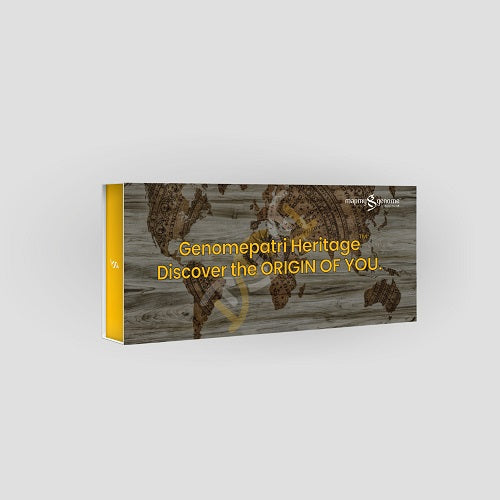
By utilizing Genomepatri Heritage, you can map your precise ethnic mix and trace the ancient paths your maternal and paternal lineages took across the Western Ghats.
Pairing these ancestral timelines with our flagship health panel, Genomepatri, gives you a complete biological manual for your long-term wellness. You can identify your personalized risks for lifestyle conditions, check your genetic efficiency for processing dietary fats, understand your body‘s specific response to stress, and design a custom nutritional and fitness routine tailored to your exact DNA.
Ready to claim the history written in your cells? Order your Genomepatri Heritage kit today and unlock the ancient warrior timeline written in your DNA.
Frequently Asked Questions (FAQs)
What does Genomepatri Heritage reveal about Maratha ancestry?
Genomepatri Heritage analyzes thousands of genetic markers (SNPs) across your genome to map your ancestral percentages. For individuals of Maratha descent, the test typically reveals a robust, deeply indigenous Western Indian genetic baseline that beautifully balances the subcontinental ANI and ASI components.
Why do genetic studies show a close connection between Marathas and Kunbis?
This closeness is a beautiful reflection of historical reality. For centuries, the Marathas and Kunbis formed a fluid socio-economic continuum in Maharashtra. Families routinely transitioned between farming the land (Kunbi) and defending it as soldiers (Maratha). Because they share the same geographic home and a history of intermarriage, their DNA profiles are fundamentally intertwined.
How does Mapmygenome distinguish Maratha DNA from other regional populations?
Mapmygenome possesses a highly advanced, pioneer database of Indian genomic profiles. By comparing your DNA against specific, localized reference panels from Western India and the Deccan Plateau, we can accurately identify the distinct patterns of haplotype sharing that define Maratha heritage.
How can understanding my Maratha heritage help me improve my modern health routine?
Because your ancestors‘ DNA evolved to thrive under conditions of high physical exertion and a traditional regional diet, a modern sedentary lifestyle can put you at a higher risk for metabolic mismatches. Pairing Genomepatri Heritage with a Genomepatri health panel helps you look ahead, giving you a comprehensive breakdown of your risks for insulin resistance, cardiac wellness, and metabolic behaviors so you can optimize your longevity.