Chitpavan Brahmin
The Chemistry of the Konkan: What DNA Says About Chitpavan Brahmin Lineage
The Konkan coast of Maharashtra is a landscape of dramatic contrasts—where rugged, dark basalt cliffs plunge into the Arabian Sea, flanked by dense coconut groves, cascading monsoons, and the orchards of the famous Alphonso mango.
From this unique coastal strip emerged the Chitpavan Brahmins (historically known as Konkanastha Brahmins). For generations, they have been a community of intense curiosity for historians and anthropologists alike. The reason? A strikingly high prevalence of physical traits rarely seen in such concentration in southwestern India: piercing light eyes (shades of grey, green, and blue), fair complexions, and distinct sharp features.
To explain these traits, local folklore crafted a highly romantic narrative. The most famous legend states that thousands of years ago, a ship carrying European, Nordic, or Bene Israel Jewish sailors was wrecked off the rocky shores of the Konkan. The survivors were supposedly purified by the sage Parashurama and integrated into the local social fabric.
It is a gripping adventure story, but what happens when modern genomics replaces maritime folklore with hard data? Through Genomepatri Heritage, Mapmygenome decodes the biological reality of this coastal lineage, revealing that the truth is a masterclass in the chemistry of geographic isolation.
Konkan waves crash down,
No foreign ships on the shore,
Deep roots in the clay.
Deconstructing the Myths: Cultural Narrative vs. Genetic Reality
When population geneticists mapped the genome of the Chitpavan community, they discovered that nature doesn‘t need a far-fetched shipwreck to create unique physical features. It only needs time, isolation, and genetics.
| The Cultural Stereotype / Myth | The Genotypic Reality Uncovered by DNA |
| The Shipwrecked European Sailor Myth: The long-standing belief that Chitpavans are a recent, displaced pocket of European or Nordic military/maritime bloodlines. | An Indigenous South Asian Architecture: Autosomal DNA completely debunks the recent European shipwreck myth. Chitpavans possess a fundamentally indigenous Indian genetic backbone, sharing deep ancestry with neighboring South-Western populations. |
| Light Eyes Mean Foreign Ancestry: The assumption that light iris pigmentation could only be introduced by recent intermingling with Western Europeans. | Preserved Ancestral Alleles: Chitpavans carry a highly elevated Ancestral North Indian (ANI) and West Asian component. The alleles for lighter pigmentation were already present in this ancient ancestral mix and were concentrated over millennia. |
| A Monolithic, Unchanging Lineage: The idea that the community‘s distinct profile has always existed in its exact modern form without any evolutionary shifts. | The Power of the Founder Effect: Their distinct genomic signature is the textbook result of a founder effect and intense genetic drift caused by centuries of strict endogamy in the isolated valleys of the Konkan coast. |
The Data-Driven Deep Dive: Unpacking the Konkan Isolation
For the Data-Driven Biohacker, the Chitpavan genome is a fascinating study in how social and geographic boundaries can reshape a population‘s genetic architecture.
-
The ANI & West Asian Elevation: While Chitpavans share a common genetic foundation with other Maharashtrian communities, their autosomal DNA reveals a significantly higher proportion of Ancestral North Indian (ANI) and West Asian ancestral components compared to their immediate geographic neighbors. This points to an ancient migration from northwest India or the Indus Valley region to the coastal Konkan strip thousands of years ago.
-
The Genetic Time Capsule: Once this ancestral group settled in the relatively isolated pocket of the Konkan coast, they began practicing strict endogamy (marrying within the community). When a small group reproduces within a closed pool for centuries, it triggers a founder effect.
-
Concentrating the Pigmentation Genes: Genes responsible for lighter eye and skin color (such as variants within the OCA2 and HERC2 gene complexes) are typically recessive. In a large, widely mixing population, these traits tend to be diluted. However, within an endogamous population, these genetic variants become concentrated over generations. This process—genetic drift—is the real biological architect behind those famous Konkan eyes.
The Preventive Planner‘s Perspective: Why Coastline Genetics Matter to Your Health
Unlocking an ancestry shaped by centuries of endogamy and geographic isolation is one of the most powerful tools you can possess for your preventive healthcare in 2026.
The Biological Reality: The exact same evolutionary mechanisms that preserved the community‘s unique physical traits and ancient ancestral markers also preserved and concentrated specific health variations. Isolated gene pools pass down metabolic behaviors, cardiovascular predispositions, and drug responses in highly predictable patterns.
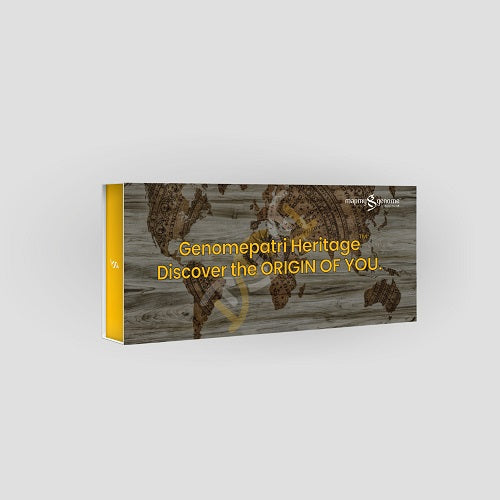
By utilizing Genomepatri Heritage, you can map your precise ethnic percentages and discover how your maternal and paternal lineages traveled to the western coast.
Pairing these ancestral timelines with our flagship health panel, Genomepatri, allows you to turn historical data into actionable longevity strategies. You can find out how your body processes fats, screen for specific inherited conditions common to closed gene pools, understand your ancestral metabolic rate, and build a personalized wellness routine tailored to your exact DNA.
Ready to see past the folklore? Order your Genomepatri Heritage kit today and unlock the true history written in your DNA.
Frequently Asked Questions (FAQs)
Does Genomepatri Heritage check for European or Jewish ancestry in Chitpavan lines?
Yes. Genomepatri Heritage compares your DNA against an extensive global reference database that includes European, Middle Eastern, Central Asian, and highly specific regional Indian populations. For individuals of Chitpavan descent, the test reveals a deep, ancient West Asian and Ancestral North Indian (ANI) component rather than any recent European or Nordic shipwrecked markers.
Why do many Chitpavan Brahmins have light eyes if they are indigenous to India?
Light eye color is determined by specific genetic variations (such as those in the HERC2 and OCA2 genes). These variants existed in ancient ancestral Indian populations, particularly those with high ANI components. Centuries of strict community endogamy and geographic isolation along the Konkan coast allowed these recessive traits to match up and become highly concentrated within the population.
What is a "founder effect," and how does it relate to this community?
A founder effect occurs when a new population is established by a small number of individuals from a larger ancestral pool. Because this smaller group is isolated—either by geography like the Konkan cliffs or by social custom—their specific genetic traits become magnified over generations. This is exactly how the distinct genetic and physical signature of the Chitpavan community was preserved.
How does pairing an ancestry test with a health panel benefit someone from this community?
Because generations of endogamy pass down genetic variants in a highly predictable loop, certain health risks, metabolic rates, and drug responses become specific to the population. Pairing Genomepatri Heritage with the Genomepatri health panel gives you a complete, highly localized health blueprint, helping you catch potential inherited risks early and tailor your diet and fitness to your ancestral biology.